Posts mit dem Label winnie werden angezeigt. Alle Posts anzeigen

Freitag, 23. Januar 2009

Montag, 29. Dezember 2008

winnie [aggregates models, work in progress]

The physical model of the component aggregation is still building up, but the shadow and the layering effect are starting to perform as expected. The next task is to fill up a volume with reserved spaces, that is going to be exciting result.

Observing how my little natural builder aggregate his "components" also give me some inspirations and motivations to continue this exploration. Another inspiration come from the hairy surface of the hendecahedra. Is it possible to make the component flexible and give this "soft" texture instead of the rigid texture from the physical model?

Finally, working in Maya has brought me so much frustrations because Particles doesn't work in my case. The only model that getting close to imitate the behaviour of the physical model would be using Instance copy and animate the objects with gravity field. But this Maya model containing only 32 simplified components already dragged the computer to almost frozen... don't know how to continue...


"In their bound form, aggregates are by far the most ubiquitous materials in architectural construction. However, there are few precedents for using loose aggregates in any significant way, despite their ability to swiftly interact with a given environment. Michael Hensel and Achim Menges argue for a better understanding of the behaviour of such materials in order that they can be used in their loose form. Aggregates are formed not through the connection of elements with joints or a binding matrix, but through the loose accumulation of separate elements. This approach therefore requires a radical departure from architectural design based on assemblies and assembly processes." - Architectural Design, March/April 2008.


Sonntag, 14. Dezember 2008

Samstag, 6. Dezember 2008

Donnerstag, 4. Dezember 2008

winnie [morphological component part 2]

After discussion with Sandra, I decided to (should I?) abort the honeycomb approach for creating a component and go back to develop the component from more experiments... I have highlighted the component which could be interesting to me... I will make aggregation of some components tomorrow to look for interesting / surprising effects...

QUESTION: which components are most successful members in these families and why?


Samstag, 22. November 2008

Dienstag, 18. November 2008

Montag, 17. November 2008

[part-to-whole component] : work-in-progress

In searching for a form for the component, I consider the part-to-whole and whole-to-part as one concept, that mean the component should follow the same logic as the whole form. I start brain storming from the whole and there should be 3 main elements in the form (I can explain why that is 3 from the site analysis), in the blue model case, the element is a tunnel.

Then I move on to test a form for the component which is able to be combined flexibly. I continue the concept of "the magic 3", testing the kind of join and repeating effect. The model is still developing, the last model is developed from the same component with more aperture and without smoothing the hard edge.

The next category of component I want to test would be a more light weight component making from frameworks. The clock is ticking and the battle with it will go on... but your comments would be the fuel... danke :)


Sonntag, 9. November 2008

Hendecahedra wall

Hendecahedron surface design


There are 3 main designs named: Plumage, Venation and Apertures. 

Plumage series are devised from a single curve line in the middle of each surface, then blend to the edge. 2 variations of plumage named Plumage Continuity and Plumage Flow produce different kind of feather-like apertures on the surface.

In Plumage Continuity, the continuous line (in green) will be embossed on the surface.

Venation is based on the structure of the veins on a leaf in response to the edges of the Hendecahedron as the main veins.

Apertures is simply testing the surface with different sizes of apertures.

Dienstag, 4. November 2008

first experiment from TopMod


The first experiment is simply a donut form with a twisted tunnel... but the accidental effects on the surface of the model in Maya is something I want to add on the model as details...

Montag, 27. Oktober 2008

ATLAS OF NOVEL TECTONICS by reiser + umemoto [part 4]

[6 Part-to-Whole Relationships]

The top-down hierarchy in the modernist project is no longer sufficient to enable the new organizations and new architectural effects out of wholes. Instead, the authour suggests a methodology which involve both top-down and bottom-up logics operating in a feedback loop. So the parts are able to affect the whole and vice versa.

As an example, the Flux room done by Reiser and Umemoto in New York is a flexible space created to demostrate the changing effects of magnetic fields. Each magnetic needles is affected by the magnetic field in the room and different pattern is formed in the room as a whole. The variation in composition is only possible to be shown with a sufficient quantity of elements.


[7 After Collage: Two Conditions of the Generic]

According to the author, two kinds of conditions are suggested in replacement of the collage of mere difference as in the modernist model. The first condition use simple unit repeated along a variable trajectory and the second condition is the opposite of the first, use variable unit repeated along a simple trajectory. In this way, transformation is resulted from quantity.


Sonntag, 26. Oktober 2008

ATLAS OF NOVEL TECTONICS by reiser + umemoto [part 3]

[3 The Unformed Generic: Form Acquiring Content]

The author first quoted Leonardo da Vinci interpretation of stain to illustrate the possibilities in programs and compositions out of an unspecific form. "the stain represents a specific form of the generic that is at once both general and specific. ... They occupy the space between the abstract and the concrete. Like Leonardo, we start from the middle, projecting material into a diagrammatic field."

[4 Similarity and Difference]

Gilles Deleuze and Fèlix Guattari use the analogy of racehorse being closer to a grey-hound, and a draft horse being closer to an ox, than each is to the other. In terms of performance, they are similar even though they look different. Similarly, elements in a self-similar structure could behave differently even though they look similar.

[5 Variety (Difference) vs. Variation (Self-similarity)]

Back to the concept of fineness, "Quantity is a precondition to fineness." From Edgar Allan Poe's theory of composition, "The logic of repetition, like the logic of statistics or the logic of information, can be applied regardless of content." Out of this concept, pattern is formed. Therefore a single element in architecture is not enough to bring out the possibilities in organization compare to a greater quantity of them.

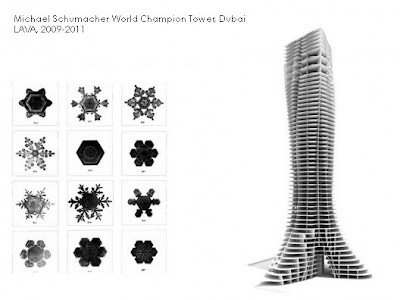
For example, the Michael Schumacher World Champion Tower in Dubai was inspired by the geometric laws of snowflakes. Even though the building's appearance is constantly changing by tracking the sun, the curvature on the surface actually allow potential standardisation in the building process because of a lot of repetition. Combining with other sustainable features, this building is not only iconic, but also achieve a sustainable performance.

Samstag, 25. Oktober 2008

ATLAS OF NOVEL TECTONICS by reiser + umemoto [part 2]

[2 Difference in Kind/Difference in Degree]

The author used the analogy of the games of Chess and Go from Gilles Deleuze to illustrate the difference between classical architecture and their work. As in Chess, elements in classical architecture have their own clear and fixed identity. Whereas in Go, each element's meaning only exist in the contextual relationships with other elements. The column-like structure in a meshwork is no longer a column as in classical model, but a specific behavior and effects of the tension rods which becomes both ornament and structure.

For example, the Borneo Sporenburg brdiges erected in Amsterdam formed a continuous meandering structure over the river. The meshwork works as the structure, ornament and the bridge itself.

ATLAS OF NOVEL TECTONICS by reiser + umemoto [part 1]

[1 Fineness]

Architecture is not single thing but is working with multiple models, surfaces, and materials at different scales. The organization of the elements or parts is then crucial and the term fineness is used to describe the balance between material geometry and force in architecture. The right fineness with the right scale become a successful structure as in Glass Sponge, also known as the Venus Flower Basket, a sponge live in deep ocean.

The fibres that exist in this kind of sponge works as optical fibres. They conduct light beautifully when they are illuminated and they are more flexible then the commercial fibre. One can tie knots tight without cracking or breaking them. Unlike the human fibre optics which can only be produced with a high-temperature furnance and expensive equipment, these biological fibres can be produced at sea water temperature. Finally, according to AnAge Database, these creatures have a lifespans of 15,000 years, no wonder being the longest among all creatures.

The same fineness in structure can be found in 3XN's Tivoli Concert Hall in Copenhagen, Denmark. The shell is a light, transparent and delicate structure formed by white lacquered, twisted alu strings. It reflects the sun in days and beautifully frames the lamps at night.


Dienstag, 21. Oktober 2008

Excursion: [Munich day 2]

13:34 [Ohel Jakob synagogue]
Rena Wandel-Hoefer & Wolfgang Lorch

Sankt-Jakobs-Platz