Sonntag, 23. November 2008

Alice


Family 1


Family 2


Family 3

Samstag, 22. November 2008

Freitag, 21. November 2008

Donnerstag, 20. November 2008

corroded models and others


I try to use my technique to application corroded surface in design of buildings but I am not sure if I am on a right path...

cellular patterns


I try to looking on mathematic sequence to create cellular patterns which generated by geometry form

Mittwoch, 19. November 2008

Alice_Last Research presented


Alice

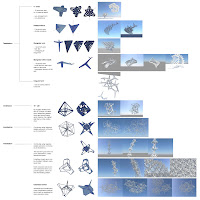
Above are the list of components playing with different geometries. The upper part of the trials show the different types of components: compacted, surfaces, bone-like. I am not sure which is the right type yet.

Then, I did look at various tessellation and space-filling polyhedra. I actually get inspired by 16-cell, a four-dimensional dipyramid and develop components in the lower part of the list. I use wireframe to review the interlocking within the component. I think some create cloud-like image, but I still doubt weather it's just a formal issue, not meaning the component itself is intelligent or embedded the idea of BwO....something is still missing and wait to be tested out ....

So, I am looking deeper into the Blur Building by D+S(R) to understand what Cloud/Blur Effect means to architecture of BwO. I think I have to understand what is Architecture of Atmosphere in order to not take that literally. I would also like to look at what aggregates and granular behavior are, which may also have particle behavior like cloud. 

Questions are 
- what are different ways of creating blur?
- what are responsive system? 
- what are different forms/effects of Ornamentation? How can differentiation happen in ornamentation? 


Dienstag, 18. November 2008

corroded models


I post my coroded models and my experiences with lights in renderings. I am still working on the shapes of my objects.

another model

Morphogenesis of ornament


The process of development is achieved through the principle of morphogenesis. The genetic algorithm, as cube-like structure as originator that starts to grow as a series of process, just like any living organism, the algorithm follows its evolution logic to attain the task; either form of building or ornament. The growth of living beings are a characteristic example of self-organization from a single seed, egg or cell and represent as the model for the logic rooted in the genetic algorithm for developing the strategy. By varying the initial position of the seeds, eggs or cells (cube) try to achieve a number of totally different formations and variations. Models create the simultaneous growth of individual elements, which due to their closeness have an interconnected evolution, some of them generating a common structure. Try to achieve and work with the same concept just like in the natural evolutionary process with slight variations on the genetic code can breed unpredictable results.